
Welcome to DigameXtra !
The Most Popular English Language Daily Newsletter In Andalucia
**********
DigameXtra Featured Sponsor

**********
Today is a holiday in Torrox, so no regular issue is scheduled. Instead, being the workaholic that I am, I present my latest article…
The Ceuta Border Crisis– A DigameXtra Investigation & Analysis
3 Part Article by Naythan, Editor, DigameXtra.com
**********
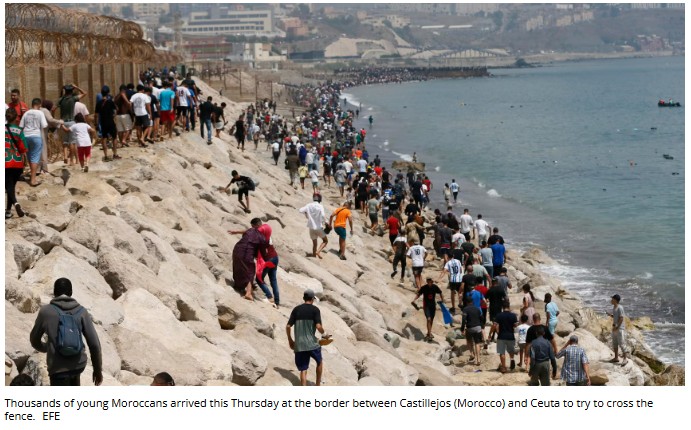
Part 1 – How did a gathering and subsequent surge of 72,000+ migrants into a tiny Spanish enclave go unnoticed in the days leading up to the event?
– In a 48 hour period last week, a government estimate of 72,000 people crossed from Morocco into Ceuta – up to three-quarters of the city’s entire population.[13] Mostly young Moroccan men, but with a significant number of men from other African nations, plus some women and hundreds of children, swam, waded or floated around the El Tarajal breakwater into Spanish territory in one of the largest sudden border surges in modern European history. Days later, the question of who – or what – orchestrated it remains unresolved.
– Most of those who entered have since returned to Morocco, either voluntarily or through coordinated procedures, but hundreds remained in Ceuta, with groups reported in streets, parks, coastal areas and the hills surrounding the city. Many were also concentrated near the Temporary Centre for Immigrant Reception (CETI), which was already beyond capacity during the emergency.[1][2] More than 1,000 people required medical attention during the crisis, while recovery teams continued searching coastal areas as the confirmed death toll increased.[1]
– Spanish authorities initially blamed migrant trafficking networks for encouraging and facilitating the mass arrival. However, subsequent reports indicate that the mobilisation involved several factors, including social media campaigns, online discussions about Spanish immigration law, advance preparation by participants and possible exploitation by organised criminal groups after the initial crossings.[3][4][5]
– One of the strongest elements emerging from investigations is the role of social media. Spanish and Moroccan reports describe Facebook groups, TikTok videos, Instagram posts, WhatsApp messages and X accounts being used during July to share information about travelling to Ceuta, including routes, meeting points and updates from people attempting the crossing.[4][5][6] Reports from Morocco described online groups where users exchanged information about reaching the border area, while Spanish investigations identified videos encouraging young Moroccans to participate and showing possible crossing routes. The online activity does not identify a single organiser behind the movement. Instead, available reports point towards a decentralised mobilisation in which different accounts and groups spread similar messages, allowing large numbers of people to act at the same time.[6]
– Another factor being examined is the influence of a recent Spanish Supreme Court ruling concerning migrants arriving by sea. Following the ruling, simplified interpretations circulated online suggesting that migrants who reached Spanish territory by swimming from Morocco could not immediately be returned.[5][7] Several reports indicate that this interpretation became one of the main messages circulating among potential participants. The belief that reaching Ceuta by sea offered a greater chance of remaining in Spain appears to have encouraged some migrants to attempt the crossing.[5][6][7] More about this in Part 2.
– Evidence also suggests that many participants prepared before travelling. Reports indicate that wetsuits, flotation devices and other equipment were being purchased in northern Morocco before the mass crossings took place.[8] Social media posts reportedly included advice about equipment and routes towards Ceuta.[6][8] The preparation does not prove that a central organisation planned the operation, but it suggests that many participants had decided to travel before the crossings began rather than acting spontaneously on the day.
– The sequence of events has therefore become a key part of the investigation. Online activity increased during July, information about the Supreme Court ruling spread widely, equipment was reportedly purchased in advance, and thousands of people travelled towards Ceuta within a short period.[6][7][8] The remaining questions include who first promoted the mobilisation, how widely it was amplified, what role criminal networks played and whether authorities on either side of the border had advance knowledge of the scale of the movement.
Part 2 – Morocco, trafficking networks and intelligence warnings
– Spanish authorities initially blamed criminal “migrant trafficking networks” for the mass arrival, but available evidence suggests their role may have been more significant after the crossings than in organising the initial movement.[3] Most migrants entered Ceuta by swimming around the El Tarajal breakwater, using flotation devices or wetsuits rather than organised boats. After the crossings, the Guardia Civil investigated attempts by criminal groups to move migrants from Ceuta towards mainland Spain, including operations involving jet skis and speedboats around the Campo de Gibraltar coast.[3][4] Reports indicate that criminal groups may have attempted to exploit the situation afterwards, while social media played a central role in spreading information and encouraging participation.
– Morocco’s role remains one of the main unresolved issues. Several Spanish reports claim that the Guardia Civil detected Moroccan intelligence agents among the migrants who entered Ceuta.[5] The presence of intelligence personnel does not prove that Morocco organised the operation, as security services may also monitor major border movements. Other reports suggest that Morocco may have allowed the mobilisation to develop because of wider tensions with Spain, including disputes over migration and diplomatic issues.[6] However, publicly available evidence does not currently prove that Rabat planned or directed the mass crossing.
– A separate investigation concerns possible Algerian links. According to La Razón, some online activity connected with the mobilisation involved WhatsApp groups using Algerian telephone numbers.[7] This indicates that the online campaign extended beyond Morocco, but does not prove involvement by the Algerian Government. The accounts could belong to private individuals, migrant networks or other groups. The wider online mobilisation shows that information about the crossing spread across multiple networks, but responsibility for creating or directing those networks remains unclear.
– The question of advance warnings has become a major political dispute in Spain. Several reports claim that the National Intelligence Centre (CNI) specifically warned authorities before the crisis that online activity indicated a growing risk of a large-scale attempt to reach Ceuta.[8][9] The Government denies receiving a specific warning predicting the scale of the eventual crossing.[8] The dispute centres on what information existed, when it was received and how it was assessed. A general warning about increased migration pressure would not necessarily have predicted that tens of thousands of people would attempt the crossing within days.
– The Government’s handling of the crisis has also generated controversy. Opposition parties accuse the authorities of minimising the seriousness of the situation and failing to act on warnings, while ministers reject those claims.[8][9] Further controversy followed reports that information published by General Loreto Hurtado, head of Spain’s National Security Department, estimating the number of migrants crossing into Ceuta, resulted in her summary dismissal.[11] This has increased political debate over how the Government communicated the emergency, and raises questions as to why the government would punish a high ranking official for letting crucial facts be known to Ceuta’s residents.
– The Interior Ministry has installed a containment barrier at the El Tarajal breakwater, saying it is intended to strengthen border security and prevent future mass swimming crossings from Morocco.[12] Critics argue that the barrier, being relatively low, would not physically stop determined swimmers. Its main purpose may be linked to border identification, or the application of immigration procedures. Following recent court decisions concerning returns, as those arriving by sea cannot be immediately returned but must be processed, while those arriving by land, or by “evading barriers”, such as this floating “containment barrier”, can be returned immediately.[12]
Part 3 – Conclusions and sources
– The available evidence indicates that the Ceuta crisis was the result of several overlapping factors rather than a single cause. Social media provided the mechanism for rapid mobilisation, while online discussions about Spanish immigration procedures and the Supreme Court ruling appear to have influenced expectations among some participants.[4][5][7]
– The evidence also suggests that many migrants prepared before travelling, with reports of equipment purchases and online sharing of routes and crossing information before the mass arrival.[6][8] However, the available information does not establish who first initiated the mobilisation or whether any organisation controlled the movement.
– The role of criminal networks remains unclear. While authorities have investigated trafficking groups attempting to exploit the aftermath of the crossings, there is currently no public evidence proving that traditional smuggling networks organised the original mass entry.[3][4]
– Questions also remain over the role of Morocco and the actions of Spanish authorities. Reports concerning Moroccan intelligence personnel among the migrants, possible prior knowledge of the mobilisation and claims of advance warnings from Spanish intelligence agencies have increased political pressure for further investigation.[5][8][9][10] At present, these reports raise questions but do not provide definitive proof of direct state involvement by any country.
– The Ceuta crisis demonstrates how digital communication can transform a local border event into a large-scale movement within a short period. The combination of social media “flash-mob” style mobilisation, legal expectations, advance preparation and geopolitical tensions created conditions that allowed tens of thousands of people to attempt the crossing almost simultaneously.
– Further investigation will be needed to determine who promoted the mobilisation, how much authorities on both sides of the border knew beforehand, and whether additional measures could have reduced the scale of the crisis.
**The latest news before publication**
– At last count, the government reports 75 deaths.[14]
– Authorities in Ceuta said they are currently caring for around 1,000 unaccompanied migrant children who remain in the enclave after the crossing. The Spanish government has also announced an additional €25 million ($29 million) in emergency funding to support their care.[15]
– New reports claim young men from Morocco are promoting a new mass assault on Ceuta next week, the night of Saturday, August 15th.[14]
Bibliography
[1] Associated Press.
Thousands of migrants streamed into Spain’s Ceuta from Morocco, overwhelming police and border forces.
https://apnews.com/article/spain-ceuta-tarajal-morocco-migrants-5c864e5f951e2a7cf7a3eac417668e97
[2] Europa Press.
More than 50 migrants leave for other autonomous communities from an overcrowded CETI in Ceuta.
https://www.europapress.es/ceuta-y-melilla/noticia-mas-50-migrantes-parten-otras-comunidades-autonomas-ceti-ceuta-saturado-20260211164142.html
[3] Teleprensa.
Gavira blames Sánchez and Morocco for “transferring” the migration crisis from Ceuta to the Andalusian coast.
https://www.teleprensa.com/articulo/sevilla/gavira-responsabiliza-sanchez-marruecos-trasladar-crisis-migratoria-ceuta-litoral-andaluz/202608021732222480503.html
[4] Hespress.
Reports on Facebook groups, social media mobilisation and online coordination connected with the Ceuta crossings. Maps, fins and sea updates: Inside the Facebook group linked to Ceuta mass crossing.
Ref: https://en.hespress.com/142952-maps-fins-and-sea-updates-inside-the-facebook-group-linked-to-ceuta-mass-crossing.html
[5] El Español.
The Civil Guard detects Moroccan intelligence agents among the migrants who infiltrated Ceuta.
https://www.elespanol.com/espana/20260802/guardia-civil-detecta-agentes-inteligencia-marruecos-migrantes-colaron-ceuta/1003744340316_0.html
[6] El Español.
Los motivos ocultos del caos de Ceuta: el deseo alauita y la turbulenta relación que ve la prensa internacional.
https://www.elespanol.com/espana/politica/20260802/motivos-ocultos-caos-ceuta-deseo-alauita-turbulenta-relacion-ve-prensa-internacional/1003744341844_0.html
[7] La Razón.
The “invasion” of Ceuta was fueled from July onwards by social media, especially from Algeria.
https://www.larazon.es/espana/invasion-ceuta-estuvo-dinamizada-julio-redes-sociales-especial-argelia_202608026a6f8fe471b42a0b5dd5c4a6.html
[8] OKDiario.
The government denies warnings of the invasion, but wetsuits and floats were already being sold in Morocco days before.
https://okdiario.com/espana/gobierno-niega-avisos-invasion-pero-marruecos-ya-vendian-trajes-neopreno-flotadores-dias-antes-19116434
[9] La Razón.
Ester Muñoz lashes out at Pedro Sánchez after the CNI warnings are revealed: “They lied about Ceuta and they will continue to do so”
https://www.larazon.es/espana/ester-munoz-estalla-pedro-sanchez-revelarse-avisos-cni-mintieron-ceuta-seguiran-haciendo_202608036a7082d2a046ad6ebc991c44.html
[10] La Razón.
Lawsuit filed against an advisor to Mohammed VI and the Government Delegate over the migration chaos in Ceuta.
https://www.larazon.es/espana/querella-caos-migratorio-ceuta-consejero-mohamed-delegado-gobierno_202608046a717827a046ad6ebc9b0700.html
[11] OKDiario.
Moncloa dismisses the head of press for National Security for warning on the website about the invasion of Ceuta.
https://okdiario.com/espana/moncloa-destituye-jefa-prensa-seguridad-nacional-informar-web-sobre-invasion-ceuta-19119921
[12] La Razón.
The containment barriers installed by the Government in Ceuta are now “fully” operational.
https://www.larazon.es/espana/barreras-contencion-instaladas-gobierno-ceuta-estan-plenamente-operativas_202608026a6f5acea5690f04736041d2.html
[13] La Razón.
Marlaska raises the number of migrants arriving in Ceuta to 72,000 and insists that “there was no warning” from the CNI (National Intelligence Center).
https://www.larazon.es/espana/marlaska-vuelve-defender-marruecos-ceuta-hemos-trabajado-manera-firme_202608046a71d1bea5690f047364dbf3.html
[14] La Razón.
Young men from Morocco are promoting a new mass assault on Ceuta next week.
https://www.larazon.es/espana/jovenes-marruecos-promueven-nuevo-asalto-masivo-ceuta-proxima-semana_202608046a71d579a5690f047364e6ae.html
[15] Anadolu Ajansi.
Spain says 70,000 migrants have left Ceuta as official death toll rises to 75
https://f.aa.com.tr/en/europe/spain-says-70-000-migrants-have-left-ceuta-as-official-death-toll-rises-to-75/4018188
***********
By supporting our sponsors you help support DigameXtra!
DigameXtra Sponsors





 Get Windscribe Pro or Free Versions Here





Mandy’s Tel: 680739577


Axarquia Silver & Gold Trade +34-606423869

Home Page – Based in Torrox Costa, near the bus station.
***********
How to Subscribe and make submissions: Click Link
DigameXtra cannot be responsible for incorrect info in reader or sponsor posts or event announcements. Always confirm the details to avoid disappointment.
ATTENTION! New EU internet privacy laws are now in effect, known as the General Data Protection Regulations (GDPR). I have to inform you that the DigameXtra archive saves follower’s email addresses in the WordPress server. By subscribing/following you implicitly accept this; if you make submissions you acknowledge that anyone can view old issues online and see your contact info as you provided and you accept this. If you don’t want me saving your email address do not subscribe/follow, you can unsubscribe and remove yourself from this list using the unsubscribe link at the bottom of every subscription issue. Takedown notices must include proof of ownership as well as the date and issue number of the DigameXtra issue containing the infringing content. These may be submitted to digamextra@protonmail.com. Proper takedown notices will be complied with immediately. All images have been credited or copied from what I believe to be copyright free sources.
©DigameXtra.com 2015-2026. All rights reserved. Written permission is required to republish any DigameXtra.com content. Sharing content for personal use is permissible as long as it is source credited to https://digamextra.com.


You must be logged in to post a comment.